Technologies: encryption, online banking, web hosting, password security, cloud computing
Identity theft never used to be a problem. It is the technologies and standard practices that we've employed that has led to this innovation.
We make it far to easy to steal an identity
Before online/remote banking the teller knew you by name and could verify your identity by memory. No such personal interaction is required today. We just have to input the correct information to get access to personal accounts. The main problems are we know exactly what information we need in order to gain access to the account (social security number, mother's maiden name, pin, etc) and we know exactly where to go to enter that information (bankofamerica.com, citi.com, chase.com, etc.). It's like parking a Ferrari in the ghetto and planning that no one will pick the lock.
My solution is to park your Ferrari in an undisclosed location, designing a custom key, and retaining all of the information on your person.
Back in the day people would bury their treasure. In order to steal this money, one would need to 1) know that such a treasure existed 2) know where it was buried (treasure map) and 3) traverse the desert/mountains/traps that stood in between the person and the treasure.
The closest approach employed today is a lock box. You must go to a bank, verify your identity, and enter a secure room to get at your belongings. It's like knowing that a treasure exists, having the map, and simply having to overcome the obstacles to get the reward. The problems with this is that you wouldn't keep currency in a locked box because it would lose value - you want your money working for you, not collecting dust. What we want is a digital lock box in a secret, and changing, location.
Solution: Imagine an infinitely large bank. You hold your money in a lock box in the bank. The beauty is that you get to determine where the lock box is located within this infinitely large bank. Additionally, you determine what type of 'key' is needed to open the box once it is located. Now if someone wants to steal your belongings they must know 1) that the box exists 2) where it is located within this infinitely large bank and 3) what type of key is used, and what that key is, to access the box. Much, much, much, much, much better than the current process.
So how do we do it? Use existing encryption techniques to pass secured web addresses between the user and the web server. After each time the box is accessed a new location is created and once again passed to the user. This special 'key' will exist on the user's phone/computer. In order to steal the money one would have to steal the phone/computer, know that the account existed (secret icon or hand gestures can exist to access it), know the special 'easter egg' password of slides, clicks, etc. and then know the username and password/passwords i.e., you would have to kidnap the victim in order to get at their account. This eliminates all remote thefts, and returns it to a person-on-person crime. BitCoins or other virtual currency can be used to further secure the funds.
Now I can enjoy all of the benefits of online banking with all of the security of old-fashioned banking. Make theft labor intensive and it will go away.
Friday, February 8, 2013

Sunday, December 19, 2010
Audio Walking Stick: RFID, GPS, and Sound Guidance
Description
The idea is to assist blind people in walking through a busy city. The person can carry a mobile device that will provide audio guidance that will keep the person walking on sidewalks and allow them to identify their surroundings without having to search for the braille signs.

Key Points
- Place RFID cards in descriptive signs (these are the signs that currently have braille).
- Map walking routes by collecting GPS information from mobile phone users. Use these routes to provide walking assistance.
- Write a program that assembles this information and makes it available in a mobile device for on-the-go assistance.


Friday, December 3, 2010
BatteryBox: RedBox For Your Cell Phone Battery

BatteryBox is a kiosk for the exchange of uncharged cell phone batteries for charged cell phone batteries. Customer swipes credit card, may return a used battery, and receive a charged battery. Specifically useful in airports and hotels (business travelers) as well as on college campuses, theme parks, and travel destinations: i.e. anywhere people may be away from home for a period of time. The general public are becoming increasingly dependent on cell phones for their everyday life, yet no solution exists to help when they need quick access to a charged battery.
Locations
I would initially locate my kiosks in airports, hotels, and universities. These are places where cell phone users are exceptionally tied to their phones, thus making our service more valuable in their eyes.
- 20,000 airports in US with ~1.5 BatteryBox kiosks each
- 4,100 universities in US with ~2 BatteyBox kiosks each
- Locate 1 BatteryBox in each of the top 10 hotels in each of the top 100 destination cities.
= 39,200 locations prior to standard retail outlets
Important Information
- Total cell phone market in the

User Experience
User chooses to either rent, return, or both.
- If renting, the user with select their phone type so that the proper battery is chosen. The user confirms and swipes their credit card. Charged battery is dispensed.
- If returning, the battery slot opens and the user slides the battery into the slot on the machine, much like returning a DVD to RedBox.
- If both returning and renting, the user retuns the battery and is prompted to choose the same battery type (default) or a battery for another phone. Charged battery is dispensed.
Saturday, November 20, 2010
Algorithm to Design "Green" Font - Uses Less Ink While Remaining Readable

Originally from my twitter post: http://twitter.com/newdaynewidea
The Idea:
Create an algorithm that produces ECOnomical fonts: Fonts that are both easy to read and require little ink. According to estimates, ink accounts for 60% of the cost of a printed page. If we decreased our ink consumption we could save money and help the planet.
- Printer ink can cost $10,000 per gallon.
- Century Gothic is apparently the most economical font, although it was never produced to be such.
- The University of Wisconsin - Green Bay (UWGB) recently made the switch to Century Gothic as the universal campus font. According to gizmag.com, UWGB has rolled the change last semester (Spring 2010), saying it uses 30 percent less ink than its default font Arial when printed.
Implementation:
- Computers are exceptional at finding 'best-fit' solutions, oftentimes using evolutionary algorithms to pin solutions against one another in a survival-of-the-fittest battle.
- Additionally, they can institute variation (mutations) in order to produce even better solutions from which to choose.
- It would require little effort for one to characterize the attributes of the desired font. Some examples are: Each letter does not look too different from its original shape, each new font letter must not be too similar to any other new font letters, must use less ink than currently available fonts, etc.
- Additionally, the algorithm will weight each letter's ink importance by the frequency in which each letter appears. This would mean different fonts for different languages.
Saturday, November 13, 2010
Date In A Box: The Single Guy's Savior

From my twitter account: NewDayNewIdea.
Idea: Offer pre-package, pre-portioned ingredients for a homemade meal. Package with a DVD that shows you how to make a meal. Co-market with cooking shows. Allows you to brand daily food consumption while also promoting cooking shows. Everyone either has a tv in their kitchen or a phone to watch videos. Watch corresponding cooking show at home while making your meal. Cooking shows have become very popular amongst the mid-to-late 20's crowd who have money to spend, an interest in cooking, and are looking for a fun activity. Single men do not have the pantry necessary to make a GOOD home-cooked meal. There is always one or two ingredients that are too obscure to actually keep around. These packages will have ALL of the necessary ingredients.
Implementation: Go to the supermarket, find the box for the meal you want to make, locate the matching box in the refrigeration section, bring home and be the man. Cook with your girl while watching the lesson on tv or your phone. Eat well and play better.
Sunday, October 24, 2010
Template: Keeping Future Posts Readable
Before I begin posting my genius ideas for all to enjoy, I think it is important that I create a template. This will make the posts easier to read and allow me to produce them in a timely fashion.
All posts will begin with a title. Following the title will be three rows describing the type of innovation described in the article:
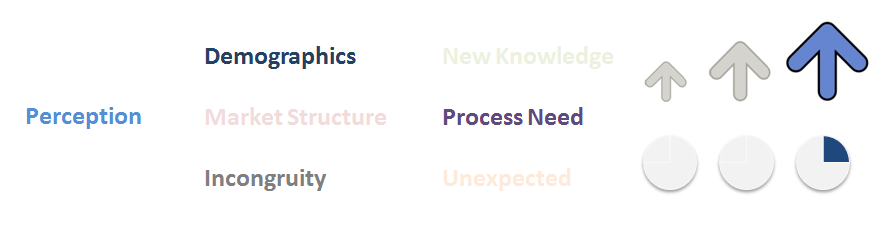
The change or changes that lead to the opportunity will be listed. These will come from Drucker's 7 Sources of Innovation:
Next, I will estimate the magnitude of the opportunity:


Following this initial section, I will give a brief Summary of the innovation and the change that brought it about. I will then describe the idea, provide images and diagrams where appropriate, and list future areas of research, as well as questions and concerns.
I hope this approach will make the experience more enjoyable.
All posts will begin with a title. Following the title will be three rows describing the type of innovation described in the article:
The change or changes that lead to the opportunity will be listed. These will come from Drucker's 7 Sources of Innovation:
Demographics
Incongruity
Market Structure
New Knowledge
Perception
Process Need
Unexpected
Next, I will estimate the magnitude of the opportunity:
I will then list the time it would take to get the idea to market. This may depend on time investment for research and development, marketing, or reliance on future technology, to name a few:
I hope this approach will make the experience more enjoyable.
Friday, October 22, 2010
Chapter 1: The First Post
Hello, and welcome to my innovation blog. As some of you may know, I have been posting my innovative ideas on twitter (NewDayNewIdea) for almost a year now; I have verbally assaulted friends with my ideas for far longer. Today I embark on a mission of documenting these ideas and transmitting them to a larger audience.
I create this blog with the goal of organizing my thoughts and assembling my favorite links and magazine articles in a single repository. By doing so I hope I will be able to assimilate useful and new ideas into my everyday life without investing too much time drudging through the web and its vast footprint.
Please feel free to comment on my ideas, I am not emotional. I post these ideas because I believe they have some value, even if that value is only to help spark future ideas.
Subscribe to:
Posts (Atom)